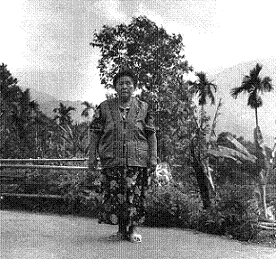


CHEN,TAO
CHEN,TAO
1922-2016

Xiaotao was born in Taipei in 1922 and was a native of Yongle Town, Dadaocheng. His mother died when he was 3 years old. His father was a fruit vendor, and his life burden was very heavy. When she was 19 years old, she was taken to the Kaohsiung Pier and boarded a Japanese warship all the way to Andaman, a small island in the Indian Ocean. She thought she was here to work as a nurse's aide, but in the end she was forced to become a "comfort woman" not far from the naval camp. I lived in a seaside comfort station for 1 year and 2 months. After that, she and five other Taiwanese women were transported to Saipan and accidentally stopped at the port of Johor, Malaysia, unable to leave. At that time, in order to survive and wait for the ship to return to Taiwan, Xiao Tao had to enter another comfort station. By the time Japan was defeated and returned to Taiwan on a Japanese Red Cross ship, she was already 24 years old.
Grandma Xiaotao said that after returning to Taiwan, she took the train back to Taipei to find her family. Unexpectedly, her grandmother and father, who loved her most, had passed away. Her family treated her with contempt and disgust, and they had no place to stay. She had no choice but to leave Taipei and work as a cook and maid, and went to Taitung to work as a tailor to support herself. She got married at the age of 28, but was forced to divorce by her mother-in-law because she could not continue the family line. She remarried at the age of 45, but she was still afraid of being looked down upon and endured the misfortunes she suffered during the war alone. After 20 peaceful years, her husband died in a car accident, leaving her alone. Grandma made a living by selling coconuts in the Pingtung market in southern Taiwan until she was over 90 years old. She lived in a makeshift tin house next to the stall, which was her only shelter. In the dark and empty market at night, grandma said, "It is always easy for a person to think about the past. No one can understand my sorrow. I often drink alone at night, one cup after another, crying while drinking. This way Forget the pain."

HUANG,A-TAO
HUANG,A-TAO AMA
1923-2011

Grandma Da Tao was always afraid of being exposed and shy at first, but later she overcame her inner shadow and became the first person to come forward and publicly appear on behalf of Taiwan's "comfort women" to face the international media and demand national compensation and a formal apology from the Japanese government. The brave man.
"When I was a child, my family was too poor to go to school. I cooked at home and helped take care of my younger siblings. My father was very strict with us and did not dare to fall in love, so I was still unmarried when I was 20 years old. One day, I saw a picture of a nurse in Nanyang. My friend asked me to sign up for the notice of my mother-in-law. Due to the war at that time, there were no jobs in the farm. Both men and women might be transferred overseas. When there was work that needed us, we were very willing to go. A Japanese man and woman They took us on a boat from Kaohsiung to Indonesia. When we got there, we found out that we were going to work as "comfort women." We were very angry and went to fight with the Japanese couple, but we couldn't go home. The Japanese thought of "laboring for the country." In the name of asking us to comfort the soldiers, when I was bullied by the Japanese army for the first time, I bled. I was so sad that I wrapped it in cloth and wanted to take it home to show my parents. I was forced to pick up more than 20 soldiers every day. I was a soldier during the day and an officer at night. I couldn't rest at all. Some Japanese soldiers would beat us after drinking. It was very painful to be vented by the Japanese soldiers. Every time, I would close my eyes and grit my teeth to get through it. Once I tried to escape, but was caught by the military police and brought back to the camp. I had no choice but to cry every night because of my resentment. When I was in Indonesia, I suffered from malaria, underwent surgery for appendicitis, my right eye was blinded by bomb fragments, my abdomen was injured and my uterus was removed. Life was really hard. Later, due to the expansion of the war, I could not return to Taiwan until three years later. "
"After I returned to Taiwan, I often had trouble sleeping at night. I only dared to tell my mother about this matter. I felt very sad. I felt that I was worthless and no one wanted to marry me. I was unwilling to do so. I was originally an innocent girl. , I was ruined by the Japanese. Later, someone wanted to marry me, but I was too inferior to agree. My friend who went back to Taiwan with me persuaded me that it would be good to have someone to take care of each other when we grow old. After thinking about it, I agreed to get married. .”
"I often go to the temple to ask Guanyin Bodhisattva to forgive me and the Golden Mother to show mercy. I did not do it voluntarily. Being bullied in the past was a sin. I worship and repent, eat vegetarian food, chant sutras, listen to sermons, and also do volunteer work in the temple. , and then I became more open-minded.”

CHEN,BAO
CHEN,BAO AMA

At the age of thirteen, in order to make money, he learned from a singing teacher from Shanghai. Since Chen Bao's grandma is not literate, the way the class is taught is that after explaining the meaning of the song, the teacher sings a line, and Chen Bao sings a line along with it. She sings two or three lines each time in class until she is proficient. If she learns quickly, The teacher will teach you a few more words. He began to perform at the "Jiangshan Tower", which was the most famous hotel in Dadaocheng at that time and a very noble social occasion. In order to accumulate the strength and courage to perform live, Chen Bao performed in front of the crowd every time he learned a piece of music. In the end, she learned more than a hundred pieces of music in total!
When she was fifteen years old, her seriously ill mother passed away. To pay huge funeral expenses, she was sold to a rich man in his sixties by her eldest sister. This is Chen Bao's first man. At the age of sixteen, she gave birth to triplets, but unfortunately all three baby boys died within a month of birth. After paying off her debt, she left the man. Later, Chen Bao fell in love with a well-known local gangster "Crazy Tu Shui". He was a very loyal person and was very kind to Chen Bao. He helped Chen Bao adopt a six-month-old girl. Named Yumi. She and "Crazy Earth Water" almost discussed marriage, but fate played tricks...
In 1941, Chen Bao was only twenty years old, but he had already experienced most of the vicissitudes of the world. The local district office sent someone to inform Chen Bao's eldest sister: Chen Bao had been selected by the authorities and would leave for Guangdong to serve in the military in three days. The eldest sister was given 40 yuan, but no contract was signed. She was only told that she would be back in six months. Chen Bao was very reluctant, but he did not dare to disobey his orders. She boarded the boat with eighteen girls, and another page of their lives unfolded. They could not go out freely and had to pick up more than a dozen guests from morning to night. After the half-year period in Guangzhou was up, the boss refused to let her go and sent them directly to Burma, where the Japanese army was attacking at the time. Three and a half years passed in the blink of an eye, but it was a painful time. Thinking of her beloved "Crazy Earth Water", her sister and brother-in-law who took care of her, and her beloved adopted daughter Yumei, she ran to the mountains to sing alone, shedding tears while singing. She didn't know when he would be able to leave this hellish place, she didn't know if her lover was already in another relationship, she didn't know if her adopted daughter still recognized her as her mother, and she didn't even dare to think about whether she could leave alive.
In 1945, when the Japanese army was at war, the "comfort women" retreated with the Japanese army and began to flee. In 1947, Chen Bao finally returned to Taiwan safely. At this time, she was 26 years old and had been away from her hometown for 6 years. After returning home, she found out that her boyfriend had remarried and her adopted daughter didn't recognize her. She was in so much pain that she once attempted suicide. At the age of 41, she married a man she didn't love as her stepmother, took care of his children, and finally had a warm family. In his later years, he lived with his adopted children and children and grandchildren, but she never dared to mention to them the painful experiences of her youth.

CHEN,LIAN-HUA
CHEN,LIAN-HUA LIAN-HUA AMA
1924-2017

Grandma Lianhua was born in Xizhi, Taipei. She was sent to the family of a family named Chen to be an adopted daughter more than four months after she was born. When she was seven years old, she entered a public school. She wrapped his books in cloth towels and walked barefoot for a long time to go to school every day. However, because his family was poor, she dropped out of school after only two years to help out at home.
"In 1944, I was nineteen years old and working as a female worker in a straw rope factory in Nangang. Although the income was low, I could still supplement the family income. One day, a Japanese came to the factory to find the boss and said that he wanted to recruit women to work as nursing assistants in the Philippines. . The next day, she came to my house with a document to find my adoptive father. Because I was under twenty years old, I needed the consent of the head of household to go abroad, but my adoptive father did not agree with my going abroad. The Japanese did not give up and ran away three times in a row. My adoptive father must allow me to go abroad. The adoptive father refused and said that his daughter had never studied nursing and had no idea how to be a nurse. The Japanese said that the job was very simple, just helping to tie bandages. The Japanese also repeatedly emphasized that many nurses Even if we go to the battlefield without fear of death, we should also do something for the country and the soldiers. The adoptive father had no choice but to stamp the seal almost half-forced."
"I boarded the ship in Keelung, and there were more than 20 people traveling with me. When I arrived in the Philippines, the interpreter responsible for roll call at the dock was Taiwanese. The Japanese call him Hidaka. She asked me in Hokkien, 'Why are you here? ?” I answered him, “I am here to be a nanny.” The man told me, “Not a nanny, but a ‘comfort woman’!” At this time, I still didn’t understand what a “comfort woman” was. When we arrived at the military camp, the Japanese couple who brought us told us that our job was to receive Japanese soldiers. When we heard this, we burst into tears. However, we could not escape in the vast sea, so we had to surrender and obey. The working hours here are from nine in the morning to twelve noon. After meals, they continue until ten in the evening. The targets are all Japanese soldiers. There is another comfort station nearby where Japanese and Korean women work. They were mainly Japanese military officers. "
In 1945, at the height of the war, the U.S. military launched a strong counterattack with island-hopping tactics. The Philippines became the area with the strongest attack power by the U.S. military. Japan then asked all troops in Cebu to retreat with the "comfort women" and flee into the mountains. The panic of the girls can be imagined.
"Mitue, who lived next door to me in the comfort station, cut off a bunch of hair and nails and put them in an iron box. She said that if she died unfortunately, she did not believe that the Japanese soldiers would bury her properly, and she did not want to become a lonely soul overseas. Wild ghost, I hope someone I know will take this iron box back to Taiwan so that her soul can return to her hometown. Mitue died during the escape. When the Japanese soldier held the iron box and asked who knew her, I silently accepted the box. Take it with you."
During the long escape, many soldiers and "comfort women" died, and the survivors learned to pity and care for each other. The miserable days did not end until the Japanese army announced their surrender. There were more than 20 "comfort women" before departure. After such hardships, only Lianhua and another woman survived.
"After the surrender, I stayed in the US military concentration camp with others, waiting for the ship to return to Taiwan. Surprisingly, I met Hidaka again in the concentration camp. When they met, the two of them asked each other invariably, 'You are still alive, not dead!' "It felt like a dream at that time. At the end of 1945, we took a boat back to Taiwan together. I returned to my hometown behind the society and told my family what I had experienced overseas. I hugged and cried with my family. Two years after returning to Taiwan, I married Hidaka, who was 13 years older than me, and moved to Tamsui to rent a house. Because I didn’t know where Mitue’s family lived, I put the iron box containing her hair and nails into the temple and prayed for her soul to rest in peace. "

SU,YIN-JIAO
Hakka AMA - SU,YIN-JIAO
1923-2009

As the eldest daughter in the family, Yinjiao worked everywhere to support the family. Her sister told her that there was a canteen in Hainan Island that was looking for waiters, so the two sisters went to Hainan Island. Only when she arrived on the deserted island did she realize that she had been deceived and became a "comfort woman" for the Japanese army. She said that because she was not good-looking, the soldiers did not like her, which made her a thorn in the side of the comfort station manager.
The landlady was very fierce and threatened them not to escape, otherwise they would be captured and shot by the anti-Japanese Red Army on the ground. The girls were terrified and had no choice but to suffer at their mercy.
Yinjiao's working hours are from 6 am to 6 pm. Since officers have the privilege to stay overnight, they dare not slack off for the officers who are armed with long knives and guns. When the soldiers were in a bad mood or drunk, they would often scold her for no apparent reason. In order to keep her safe, Yinjiao endured her life in silence.

LU,MAN-MEI
Hakka AMA - LU,MAN-MEI
1926-2011

When Manmei was three years old, her parents gave her to her uncle as an adopted daughter because her family was poor. The adoptive parents loved her very much. Since she was a child, she followed her adoptive mother to the mountains to pick tea to supplement the family's income, and thus developed the ability to distinguish between good and bad tea.
When she was seventeen years old, someone told her that there was a cafeteria in Hainan Island that was looking for waiters, and the salary was higher than in Taiwan. The filial Manmei wanted to improve the family fortune for her adoptive parents, but she was afraid that her adoptive parents would be worried if she was too far away from home, so she kept it secret. They left Hsinchu with other girls and were then taken to Hainan Island. The proprietress of the comfort station stipulated that the young and beautiful girl must pick up customers at any time, which made her miserable. When they arrived at Hainan Island, the silly Manmei didn't know what was going on until a Japanese soldier walked into the room. Manmei was so frightened that she told him, "I'm not here to do that kind of thing." The Japanese soldier said, "I bought you." This is the card, you have to do this." The first time she received a customer, Manmei was bleeding from the pain, but the nightmare did not end immediately. The boss of the comfort station saw Manmei's cuteness and designated Manmei to pick up more customers. Manmei was once hired by several Japanese soldiers to bully her for a whole day.
Manmei got pregnant the next year, but the boss ignored her and continued to ask Manmei to pick up customers until Manmei was eight months pregnant. She couldn't bear it anymore, so she asked the doctor to write a bill and bought one with all the tips she saved. Ferry ticket back to Taiwan. When the adoptive parents saw Manmei coming back with a big belly, they were afraid that Manmei would be sad, so they didn't say anything more. Manmei named the child in her belly "Haixiong", which means a child who has traveled across the ocean. Unfortunately, the child died within a few days of being born, and the adoptive parents also passed away within half a year.
After losing her family, Manmei did not recover. She worked hard to maintain her life by doing carpentry, cement, and salesmanship. However, rumors began to spread in the village that Manmei had once been a "comfort woman." In order to avoid the criticism of the villagers, , Manmei moved away from her hometown and lived in Xinpu. 20 years later, Manmei finally married her handsome husband. The husband loved Manmei very much and did not know her past. The two gave birth to a son, but he contracted polio when he was six months old. At this time, he heard about it. In Manmei's past, her attitude towards Manmei changed drastically. She often went out to look for women. In addition, she was bankrupted by her friends and accumulated millions of debts. She was exhausted physically and mentally. She died of a stroke at the age of 53. Manmei was left alone with her polio-afflicted son and an adopted son and daughter. She relied on government subsidies and doing laundry for others to make ends meet until her death.

CAI,FANG-MEI Iwal-Tanah
Taroko AMA CAI,FANG-MEI
1931

Grandma Fangmei's father was killed for participating in the Wushe Incident. Her mother's health was already in poor condition, but it worsened after giving birth to her. The family's livelihood could only rely on the help of her brothers and sisters. After entering elementary school at the age of eight, her teacher was a strict Japanese. , Cai Fangmei would be asked to take care of the children at his house after school, but would not give her food. Although life was hard, Cai Fangmei was still very happy during her schooling. Her grades were very good and she scored the highest in the class in Mandarin. A few years later, her stepfather died of illness. After her mother gave birth to her second sister, she passed away from grief because her sister unfortunately died young. Before she died, she told Cai Fangmei to go to Hualien to join her aunt. In Hualien, she married a young man from the Taroko tribe, but soon the young man was drafted to Nanyang.
One day Cai Fangmei was found at the police station and told that she was asked to work in the Oyama unit. Three months passed like this. One day, the Japanese officer suddenly told them that the working hours were extended to ten o'clock in the evening. After dinner, Cai Fangmei Fangmei was taken to a cave. When she entered the cave, she found an officer waiting for her, where she was raped. "It was very dark inside the cave. I couldn't see his face clearly. He was rude to me, and then he hugged me. I tried to break free, but I couldn't resist. I just cried. He quickly took off my clothes and hugged me hard. Press her down on the ground, and then...rape me in a hurry, feeling the stinging pain of having her vagina cut open..." During the psychotherapy workshop, Fangmei once again faced her old nightmare, and choked up several times. The staff felt distressed and couldn't bear it. .
That year, Fangmei was thirteen years old, and she was brutally raped just after her menstrual period. From that day on, she was raped by soldiers every night, and she felt fear every sunset. In this Japanese military zone not far from home, During the day, she had to wash and cook for the soldiers, and at night, she became their sex slave. He went home in the dark every night, fearing that he would be discovered by the tribesmen, so he could only cry secretly. This inhumane day lasted until Japan was defeated.
Before becoming a Japanese sex slave, she had just completed her engagement ceremony with her fiancé, who was drafted overseas to serve as a soldier and did not return until Japan was defeated. Grandma always kept this secret. Before her husband died, she bravely confessed this secret that had been hidden in her heart for a long time and asked her husband for forgiveness. After hearing this, her husband comforted Grandma and said, "Who is not at fault? The war situation was very serious at that time. Chaos, I was drafted out and did not stay by your side to protect you. The responsibility should not entirely belong to you." The burden in Grandma's heart was finally relieved. She said that after her marriage, as her husband embraced Christianity, she gradually gained inner peace through the comfort of her faith.

WU,XIU-MEI
Hakka AMA - WU,XIU-MEI
1971-2012

"In 1940, when I was deceived into becoming a "comfort woman" for the Japanese army, before boarding the warship in Kaohsiung Port, the Japanese military doctor yelled at us that we had to take off our clothes for physical examination. There were more than ten young girls with us, and no one dared I resisted, my body kept shaking, but I still obeyed the order. The forced naked humiliation is a memory that I will never be able to erase in my life. The past of more than 60 years ago is still vivid in my mind... Someone told me after I got off the boat: , that place is called Guangdong, and it is also a battlefield. Cannons are rumbling everywhere, and the port is full of soldiers. I saw a large group of Japanese soldiers who kept shouting: 'Long live! Long live!'"
"Then I was sent to a building with more than ten floors that I had never seen before. The elevators were out of service and there was no electricity. There were many rooms inside, all pitch dark. There was only one room for each person. When I looked out the window, it was always smoky. There were a lot of soldiers, and no matter how scared I was, they would be tortured by twenty or thirty Japanese soldiers every day, and I would feel so painful that I wanted to die. If I didn't go along with them or when I was drunk, they would pull out their samurai swords and threaten me, saying that they were serving the country. A loyal soldier deserves to be well served!"

LIN,SHEN-ZHONG Iyang-Apay
Taroko AMA LIN,SHEN-ZHONG
1930-2013

林沈中 Lin Shenzhong was born in 1927. She is a woman from the Taroko ethnic group, an aborigine of Taiwan. After the Pacific War broke out, all three brothers were drafted to battlefields in Southeast Asia. As a woman, Shen Zhong could not escape the cruelty of the war. "When I was seventeen, Mr. Takemura, a Japanese police officer from a local police station, ordered me to go to the army near the village. Together with several sisters from the same village, I sewed clothes, cooked and cleaned for Brother Abing. We worked from 8 a.m. to 5 p.m. every day. Because it was the police who told us, no one dared to resist. More than a month later, Nartia, who manages us, suddenly issued an order: "Starting tomorrow, we will stay and work at night, and we will have to live in the camp from now on."
"My job during the day was to be a maid, and my job at night was to provide sexual services. I was still young at the time and didn't understand these things at all. I didn't even know that I was pregnant. I was raped. I didn't know until I was bleeding heavily from my lower body and was sent to the hospital for treatment. It was a miscarriage. I was ruined like this for more than a year, and I had three miscarriages, leaving my young life with a corrupted body." "In August 1945, the Japanese army was defeated, but the news on the mountain was not clear. I didn't know that I had a chance to escape from the clutches of the Japanese army. I was still quite obedient to the Japanese soldiers. They seemed to be depressed about the defeat at that time and often drank. They had a carnival to let off steam, and a group of more than 20 sisters were asked to drink and dance with them, and in the end we were collectively raped in the same room, right on the tatami mat."
"For the aborigines, losing their virginity is a very serious matter. I didn't dare to tell the people, so I hid in the mountains and cried with Lei Chunfang, who was also victimized. I have been married four times in my life, because the shadows of the past are all The shattering ending leaves me alone and the nightmare that has haunted me for half a century. I often think that my life seemed to have ended from the day I became a comfort woman."